false marp: true theme: default size: 4K paginate: false
footer: 'Hamid Ebadi'
header: '▣ SIMLAN Project'
SIMLAN open-source project
Open-Source Simulation for Multi-Camera Robotics
The SIMLAN Framework
Hamid Ebadi, senior researcher at Infotiv AB
Research Projects
-
SMILE-IV: safety assurance framework for transport services
-
ARTWORK: The smart and connected worker
Volvo Projects
Volvo GTO in Tuve, Göteborg:
-
RITA (Robot In The Air): collaborative robot designed to assist with kitting
-
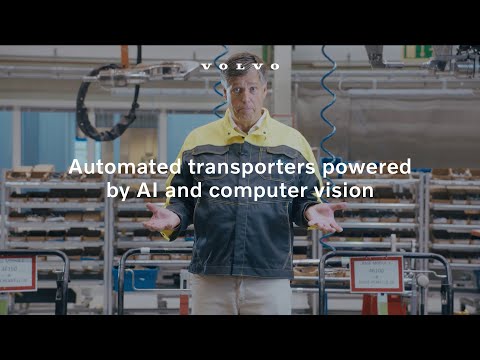
GPSS (Generic Photogrammetry-based Sensor System): ceiling-mounted cameras act as the shared "eyes" of the robot fleet. (more later)
Autonomous Robotics (intro)

Autonomous Robotics
SLAM
- Vacuum cleaner
- Simultaneous localization and mapping
- Reliance on onboard sensors
- Distributed decision making
- Communication and synchronization

Autonomous Robotics
- Limited field of view
- Sensor interference (LiDAR)
- No global view
- resolving right-of-way
- avoiding gridlock
- Handling challenging environments
- no landmarks
- repetitive landmarks
- dynamic landmarks

Centralised Robotics (pros)
- GPSS (camera-based)
- Simpler onboard computation
- Focus on control
- Energy consumption
- Simpler hardware
- Easier to maintain and upgrade
- No robot-to-robot communication

Centralised Robotics (pros)
- Improved explainability and accountability
- Camera is used for safety monitoring and repudiation.
- Improving the safety by using both onboard and offboard sensors
- More flexible to add ML based models

Centralised Robotics (cons)
- Real-time needs and latency
- Centralised processing and a single point of failure
- No mapping but only localization using fixed cameras
Continuously testing these ML systems is challenging.
Open-Source Simulation for Multi-Camera Robotics
The SIMLAN Framework
- Using simulation for complex human-robot collaboration.
- Inspired by Volvo Group’s GPSS/RITA
- Models ceiling-mounted cameras + factory layouts

SIMLAN: Asset & Environment Modeling (1)
- Realistic warehouse models
- Free/Open-source 3D software: FreeCAD, Blender
- Relevant Assets:
- shelves
- pallets
- boxes, ...
- Configurable physical properties:
- collision, inertia, mass, dimensions, visuals

SIMLAN: Asset & Environment Modeling (2)

- Sensors:
- camera
- semantic segmentation
- depth sensors
- collision sensors
- Static Elements:
- layouts
- camera coordination and orientation
- ArUco markers on agents
SIMLAN: Asset & Environment Modeling (3)
-
Dynamic Elements:
-
Pallet truck
- Forklift
- Human worker
- Robotic Arm

Multi-Agent & Namespace Support & DOMAIN ID
- Unique namespace + ArUco ID
- Spawning static & dynamic agents
- Localisation and Navigation

Camera Configuration/Calibration
- Intrinsics: focal lengths, principal point, distortion coeffs
- Extrinsics: rotation matrix + translation vector
- enables precise world-to-pixel projection
- crucial for image stitching & ArUco localization

Bird’s-Eye View & Image stitching
- transform world → camera → pixel coordinates
- enables stitching of multiple camera feeds
camera_bird_eye_viewpackage
ArUco Localization
-
proof-of-concept GPSS system in SIMLAN
-
uses OpenCV ArUco markers for localization
-
aruco_localizationpackage

ArUco Navigation
- Input:
tf2(positions) Nav2navigates (with a lot of wiring)- multi-camera robustness

Safety
"Behavior Tree" for Geo-fencing
- loss of observability
- restricted area
- collision

RITA (Robot In The Air): collaborative robot designed to assist with kitting


Panda arm demo Panda arm and humanoid demo


Gazebo Actors
- Gazebo actors: skeleton animation from COLLADA or BVH files and scripted trajectories
- Gazebo actors are static (scripted trajectories only) and cannot interact physically.
- This limits their behavior to what they are strictly scripted for

Humanoid Motion Capture

Humanoid robots replicate a real worker's movements.
- Google MediaPipe pose estimation (landmarks)
- Neural Network translates landmarks to joint controls.
- MoveIt2 handles motion planning and execution of the humanoid in Gazebo.
Summary of SIMLAN Features
- Dockerized dev environment
- Lower barriers for research in robotics/ML
- Features:
- Bird’s-eye stitching
- ArUco-based localization
- ROS 2 / Nav2 integration
- Panda arm and humanoid
SIMLAN Use Cases
- Rapid prototyping of ML-based localization/navigation
- Reproducible experiments : consistent testing
- Synthetic data generation for ML models
- Safety testing without risking physical assets
- High level of interaction reinforcement learning & genetic algorithm experimentation
- CI/CD : continuous development
- V&V to support verification and validation of complex, machine learning-based systems
SIMLAN Use Cases
Testing and Development
- Cost-efficient
- Fast
- Scalable
- Safe
- Privacy-friendly
- Reproducible (CI/CD)
Open source
- Apache 2.0 license
- SIMLAN: https://github.com/infotiv-research/SIMLAN
- Infotiv portfolio of projects (academic papers):
- https://infotiv-research.github.io/
Technical Highlights
- Middleware: ROS2 (Robot Operating System) - Jazzy Jalisco
- standard interfaces
- Simulation Engine: Ignition Gazebo, simulating
- Physics
- Sensor
- Developer environment: Docker + VS Code devcontainers (consistency and reproducibility)
- Documentation: extensive & reproducible
Testing or Development
- Simulation is for testing ONLY?
- Pushing simulation toward the entire Software Development Life Cycle (SDLC)

Future Work
Generative AI
- Style transfer w/ GANs for higher visual fidelity
- Forward diffusion process
- Reverse diffusion process
- Hallucination
- Integrate World Foundation Models (e.g., NVIDIA Cosmos)


Conclusion
- SIMLAN: powerful platform for indoor multi-camera robotics
- Reproducible, scalable, open-source
- Academia & Industry
- Roadmap: ML integration, human-robot collaboration, sim-to-real transfer
- Need your support
Acknowledgements
- INFOTIV AB
- SMILE IV (Vinnova grant 2023-00789)
- EUREKA ITEA4 ArtWork (Vinnova grant 2023-00970)
- INFOTIV Colleagues: Pär Aronsson, Anton Hill, David Espedalen, Siyu Yi, Anders Bäckelie, Jacob Rohdin, Vasiliki Kostara, Nazeeh Alhosary, Marwa Naili
- Other contributors: Tove Casparsson, Filip Melberg (Chalmers), Christoffer Johannesson, Sebastian Olsson, Hjalmar Ruscck from Dyno-robotics, Erik Brorsson (Chalmers/Volvo),
- Other Partners: Infotiv AB, RISE, Volvo Group, Dyno-Robotics, Chalmers
| INFOTIV AB | Dyno-robotics | RISE Research Institutes of Sweden | CHALMERS | Volvo Group |
|---|---|---|---|---|
 |
 |
 |
 |
 |