Model structure
model.py is responsible for routing the training and prediction to the right model. When running model.py train modelX=pytorch_model cams=[500,501] from ./control.sh, the pseudocode below in model.py loads the right model and passes the needed information for training and prediction to the model.
import modelX
modelX.train(pose_NP, motion_NP, cams)
motion = modelX.train(pose_NP, cams)
pred= modelX.train(pose_NP, cams)
modelX can now have all information that it needs for training or prediction. Each model has to define at least the following interfaces:
modelX.py:

def modelX.train():
    FL_POSE  = FLATTEN_POSE_BY_SCENARIO(pose_NP, cams)
    // 1, [LDATA_a], [LDATA_b]
    x = join(FL_POSE, motion_NP)
    // [LDATA_a], [LDATA_b], [JDATA_a]
    train with the data above
    SAVE_MODEL_AS(str(cams))

def modelX.predict(pose_NP, cams):
    FL_POSE  = FLATTEN_POSE_BY_SCENARIO(pose_NP, cams)
    LOAD_MODEL(str(cams), FL_POSE)
    WHATEVER
    return motion_np

Preprocessing
Pose landmark detected by Mediapipe:
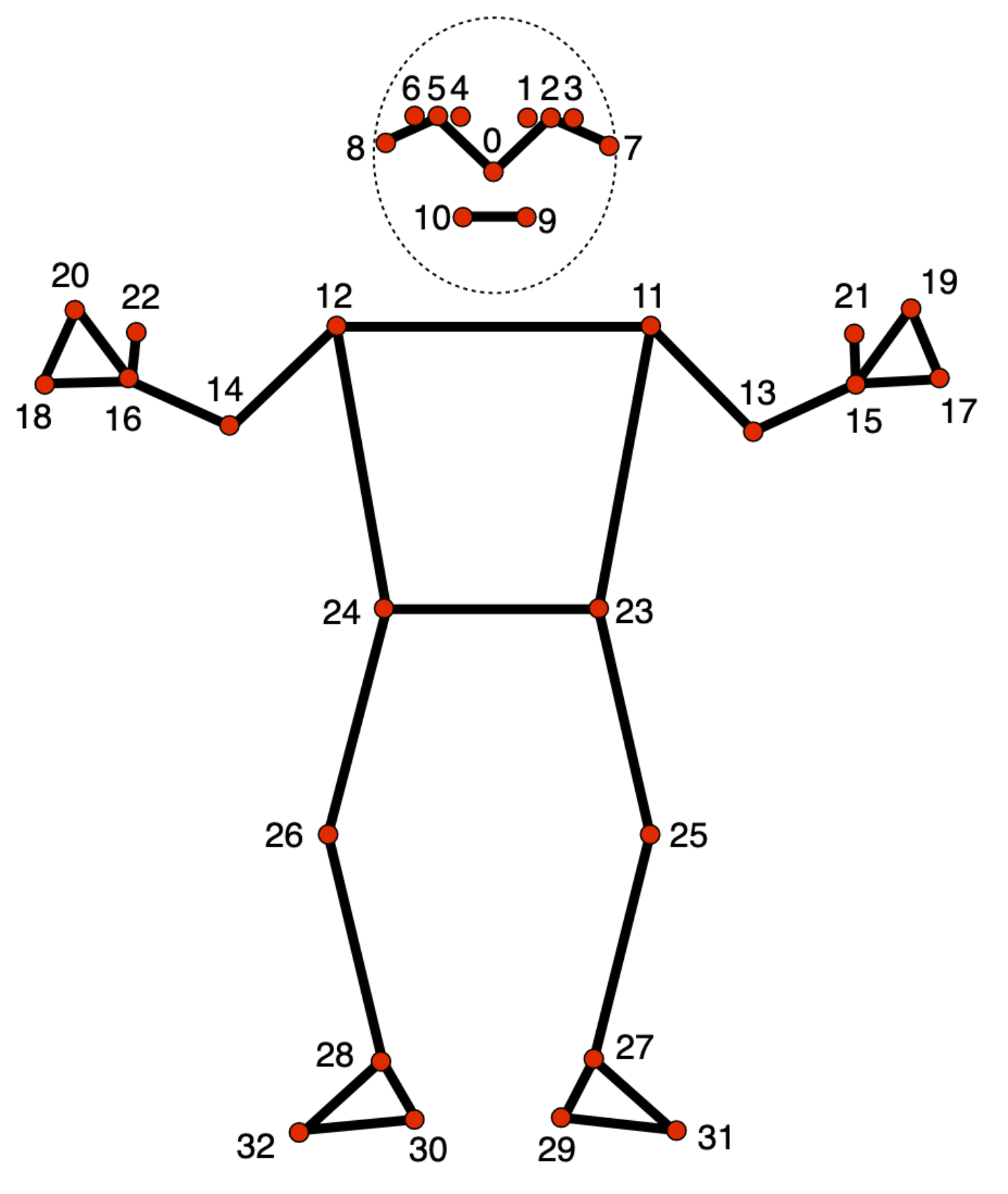
These landmarks can be normalised in many ways. Three potential steps of normalization (feature engineering) of MediaPipe landmarks:
- Position normalization
- Scale normalization
- Rotation normalization
